
THIS TIME ON CODE WACK!
Today, most people on Medicaid get their care through private insurers called Managed Care Organizations, or MCOs – like Aetna and UnitedHealthcare.
Critics say these companies add layers of bureaucracy that make it harder for patients—most of them low-income—to get care. They discourage physicians from accepting Medicaid patients by making them jump through hoops to get treatment pre-authorizations, or even to get paid.
Are Managed Care companies making health care more expensive, not less? How are some states reacting? Are legislators starting to wake up and see through the hype? Some are.
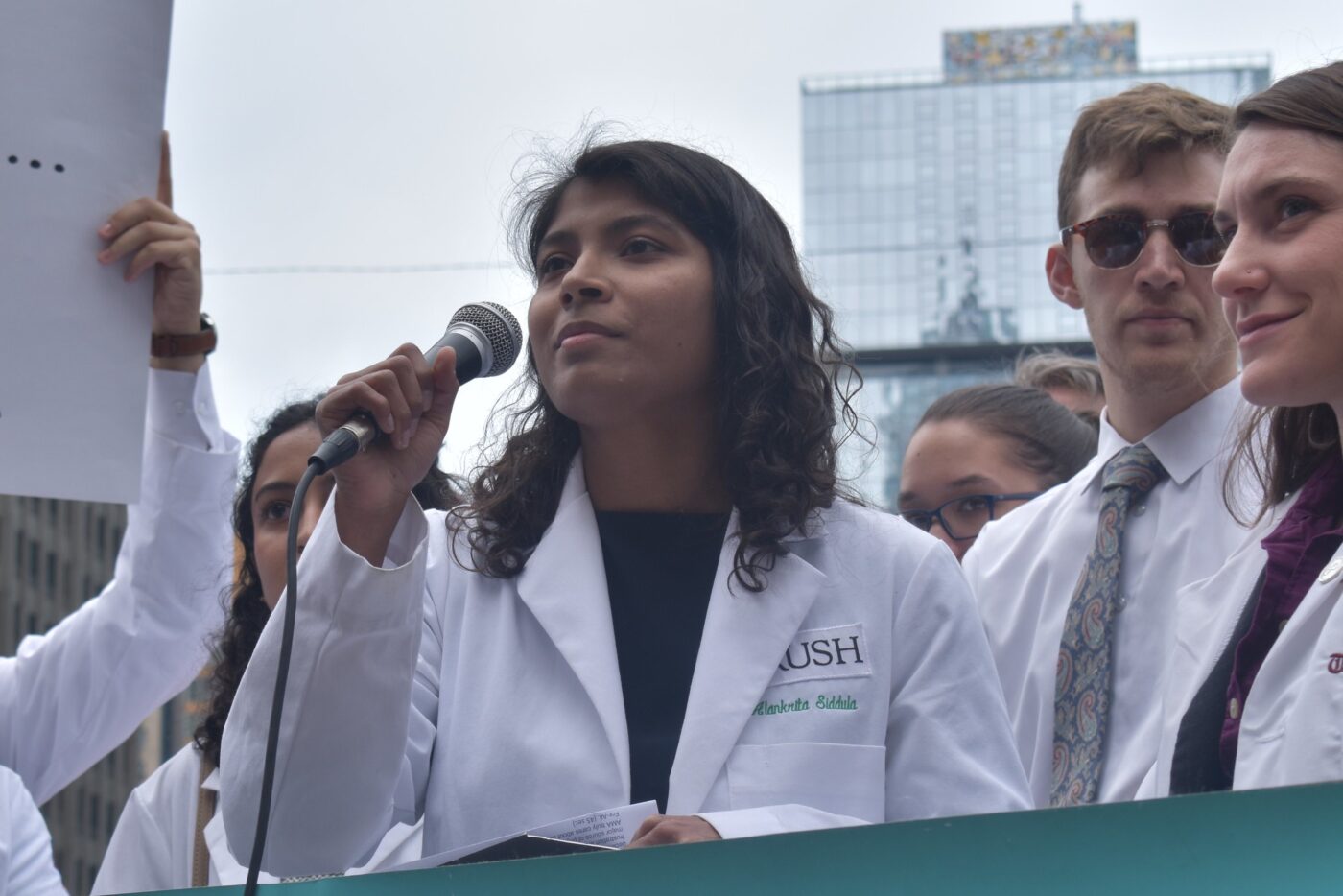
All this and more is discussed in a recent report from Physicians for a National Health Program, Removing the Middlemen from Medicaid. To unpack it, we spoke with Dr. Alankrita Olson, a public health physician and PNHP board member who advocates for a single-payer healthcare system.
This is the 2nd of a two-part series.
Check out the Transcript and Show Notes for more!
Keep Code WACK! on the air with a tax-deductible donation at heal-ca.org/donate.
SHOW NOTES
WE DISCUSS
Do you think primary care doctors are better positioned than Managed Care Organizations to coordinate patient care, and why?
Olson: “… managed care organizations … use that moniker to mean that they’re supposed to improve care coordination, but really they don’t.
Care coordination is impossible when you have these narrow networks where physicians can’t get a patient to a specialist they need because there’s only one of that [kind of ] specialist in that network. So that means a six-month wait or, you know, “this insurance is not taken here…”
… care coordination is really about making sure that you are following the patient, that you’re able to get them to what they need, and then they’re able to come back to you or they’re able to go to the next provider that can, you know, provide them care. And all that becomes hard when you have a splintered system.
And … some states have as many as 15, 16 managed care organizations. You know, in Maryland, where I am, we have nine, and all of them have different plans, and those networks are very narrow, and it just becomes very difficult to coordinate care within that splintered system.
How does switching from traditional, government-sponsored Medicaid to private insurance companies affect physician practices?
Olson: … Oklahoma’s learning this the hard way. They were one of the last few states to hold out on managed care, but unfortunately, two years ago, they moved to a managed care model, and it’s been a disaster across the board.
There’s been a lot of bureaucratic hurdles and reimbursement delays. Physicians in Oklahoma have talked about how Medicaid paid them within three days. They got the money they needed to continue to run their practice, continue to see patients, but now they’re waiting months and months. And that means that if they’re not getting actual money to be able to continue to pay their medical assistant and continue their practice ….
They’ve also seen lower reimbursements, so pediatricians are getting paid much less than they were under the traditional Medicaid administration. So that means you’ll have physicians who decide to just stop taking Medicaid, right? And so this decreases actual access to care for patients, especially children. And in Oklahoma, I believe half of [all children] are [covered] under Medicaid in that state.
Since the PNHP report came out describing how much money could be saved by eliminating Managed Care Organizations, what kind of response have you seen from policymakers, advocates, or doctors?
Olson: … We’ve seen a very positive response because this provides a real solution, an actual way to generate savings that could be used to continue to provide access to healthcare for vulnerable populations in the state …. We’ve also seen that physicians definitely support this.
… the largest support we’ve seen, of course, is among primary care physicians, you know, pediatricians, and mental health practitioners because they see the lowest reimbursements and want to be able to take Medicaid to be able to help these vulnerable populations. But in dealing with MCOs, it’s been very frustrating.… So there’s definitely been a lot of physician support for this, and we’re really seeing the support across the political spectrum.
Actually, Republicans know that their constituents will be deeply impacted by [Medicaid] cuts and you know, they can see that [eliminating MCOs] will save hundreds of millions of dollars for their state. So it’s no surprise that they’re willing to listen, willing to think about implementing this.
Helpful Links
Physicians for a National Health Program
Students for a National Health Program
Removing the Middlemen from Medicaid, A Blueprint for Better Care & Lower Costs, PNHP
AAP analysis: 49% of children insured by Medicaid or CHIP, American Academy of Pediatrics
Managed Care, Oklahoma Policy Institute
Drummond demands answers regarding failed managed Medicaid care in Oklahoma, Gentner Drummond, Oklahoma Attorney General
State scraps managed care for Medicaid’s LTC patients, McKnight’s Long-Term Care News
New Federal Medicaid Policies Compound State Budget Pressures, Pew
Episode Transcript
Read the full Transcript.
Guest Biography: Alankrita Olson, MD, MPH
Alankrita Olson, MD, MPH, is a public health physician and a proponent of a universal single-payer health program.
Dr. Olson is currently on the Board for Physicians for a National Health Program (PNHP), and she engages in advocacy around protecting and improving access to healthcare for all Americans.
Host Biography: Brenda Gazzar
Brenda Gazzar, the host and co-producer of Code WACK!, has produced over 300 weekly podcast episodes, topping 400,000 downloads. A skilled interviewer and storyteller, Brenda brings nuance, curiosity, and clarity to every conversation.
Brenda has worked as a multilingual and award-winning reporter with more than two decades of experience in California and the Middle East.
Her work has been published by Reuters, Ms. Magazine, USA Today, Los Angeles Daily News, the Orange County Register, The Wrap, The Jerusalem Post, Cairo Times, and numerous other publications. She speaks Spanish, Hebrew, and moderate Arabic and is the recipient of national, state, and regional awards.
Brenda also enjoys being a life coach, helping people align with their purpose so they feel fulfilled while achieving their boldest dreams.
Brenda’s work is grounded in a belief that systemic change and personal growth go hand in hand, and she’s here for both.
Get Involved / Take Action
Love Code WACK!? Keep us on the air with a tax-deductible donation!
Subscribe to catch all Code WACK! episodes
Subscribe to HEAL California for our Weekly News Roundup with a California twist
Join Healthy California Now – a coalition working toward a California single-payer system. Individual and organizational memberships available.
Contact Us
[email protected]
Website: HEAL California
Keywords:




You can also find us on ProgressiveVoices.com and NurseTalk Media.
This podcast is powered by HEAL California,
uplifting the voices of those fighting for healthcare justice.
____________________________________________________________________________
HEAL California is an independent news and information hub focused on the Medicare for All movement. We highlight the ongoing injustices of our broken healthcare system and amplify the voices of those who are most impacted by it, with non-partisan news, views, podcasts, and videos.
Our Podcasts shine a light on the failures of America’s healthcare system and explains how Medicare for All could help.
Our Media page offers connections to experts and additional resources, including links to legislation and studies.
Keep up with the Medicare for All movement!
Follow us on Facebook, Bluesky, and Instagram.
Subscribe for email updates, action alerts, and more!